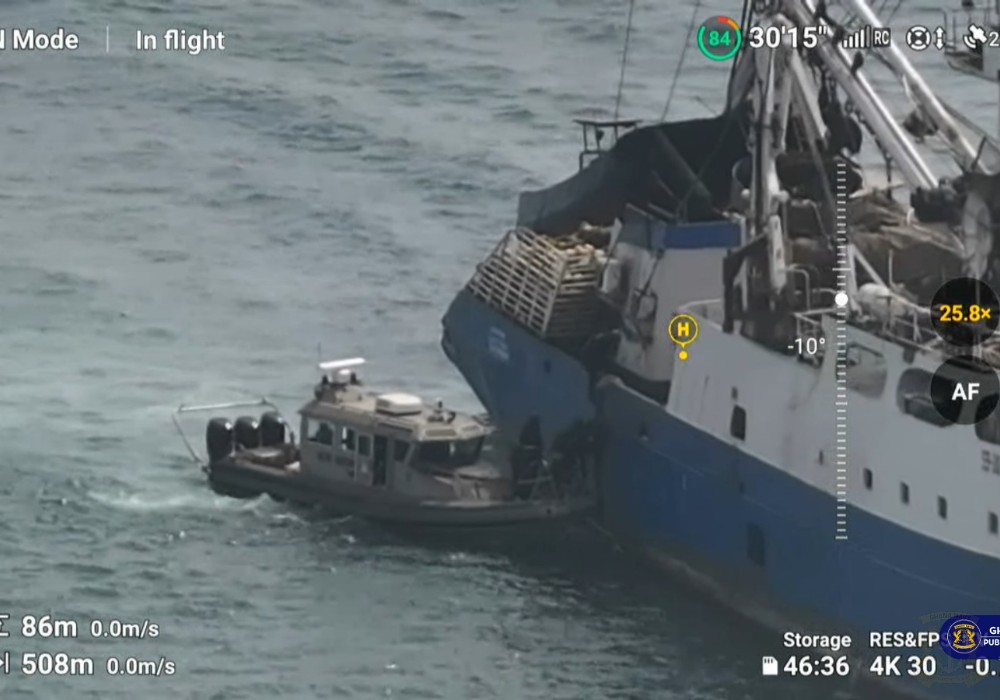
Accra, Ghana — The Ghana Navy Special Boat Squadron (SBS) has successfully executed its maiden drone-supported maritime exercise at the Eastern Naval Command, marking a significant milestone in the Service’s operational capabilities and technological integration.
The exercise brought together naval personnel, unmanned aerial systems (UAS) specialists and tactical units in a coordinated scenario designed to test real-time surveillance, reconnaissance, and rapid response in a simulated maritime security environment.
🚤 Drone Integration Enhances Maritime Operations
Military planners said the inclusion of drones transformed the exercise by enabling:
- Extended situational awareness over wide swaths of maritime domain
- Rapid detection and tracking of simulated threats
- Real-time information sharing between air and sea assets
- Improved coordination between the Special Boat Squadron and command elements
Commanding officers described the deployment of drone systems as a “force multiplier” — expanding the SBS’s reach, reducing uncertainty at sea, and supporting evidence-based decision-making during dynamic maritime scenarios.
⚓ What the Exercise Demonstrated
The maiden drone-supported exercise focused on:
🔹 Surveillance & Reconnaissance
Unmanned aerial systems surveyed designated sectors to locate simulated targets, map vessel activity, and relay communications to naval command.
🔹 Rapid Interdiction
SBS fast boats conducted coordinated maneuvers in response to verified contacts, showcasing tactical agility and interoperability with UAS assets.
🔹 Information Fusion
Data collected by drones was integrated into naval operations centres to accelerate decision cycles and improve mission effectiveness.
Senior Navy officials noted that such integrated exercises are essential for adapting to modern maritime threats — including smuggling, piracy, illegal fishing and unregulated sea traffic — which often require rapid response and enhanced domain awareness.
🛡️ Strategic Importance for Ghana’s Maritime Security
The Ghana Navy’s adaptation of drone technology into training reflects broader global trends in maritime security, where unmanned systems are being used to augment conventional sea and air platforms.
Experts say that improved maritime domain awareness (MDA) — supported by unmanned sensors — allows naval forces to:
- Detect threats farther offshore
- Reduce reaction times to suspicious activity
- Deploy assets more efficiently
- Support evidence-based prosecution of maritime crime
For Ghana — with a lengthy coastline along the Gulf of Guinea — enhanced MDA is crucial in addressing security challenges that range from piracy and armed robbery to cross-border trafficking and illegal fishing.
Related Stories
- Original MaritimAfrica report: Ghana Navy Special Boat Squadron conducts maiden drone-supported exercise at Eastern Naval Command — https://maritimafrica.com/en/ghana-navy-special-boat-squadron-conducts-maiden-drone-supported-exercise-at-eastern-naval-command/
- Ghana Navy Official Website: (insert official navy URL if available)
- Gulf of Guinea Maritime Security Overview: https://www.un.org/africarenewal/magazine/may-2023/security-maritime-africa
- Use of Drones in Maritime Surveillance (IMO guidance): https://www.imo.org/en/OurWork/Safety/Pages/Unmanned-Surface-Vessels.aspx
- Maritime Security Challenges in the Gulf of Guinea: https://www.chathamhouse.org/2023/10/understanding-maritime-security-gulf-guinea